C++ std::exception

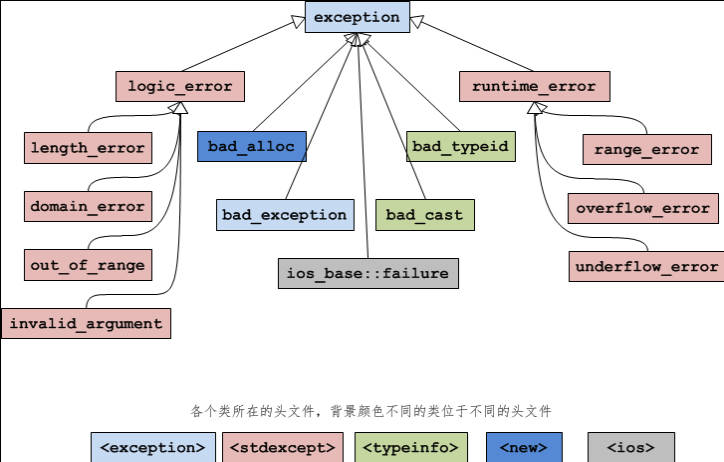
C++ 语言本身或者标准库抛出的异常都是 exception 的子类,称为标准异常(Standard Exception)。可以通过下面的语句来捕获所有的标准异常:

1
2
3
4
5
try{
//可能抛出异常的语句
}catch(exception &e){
//处理异常的语句
}

一、简介

std::exception:标准异常类的基类,其类的声明在头文件 <exception> 中。所有标准库的异常类均继承于此类,因此通过引用类型可以捕获所有标准异常。

std::exception 类定义了无参构造函数、拷贝构造函数、拷贝赋值运算符、一个虚析构函数和一个名为 what 的无参虚成员。其中 what 函数返回一个 const char*,该指针指向一个以 null 结尾的字符数组,并且确保不会抛出任何异常,该字符串的目的是提供关于异常的一些文本信息。除析构函数外,其它函数均通过关键字 noexcept 说明此函数不会抛出异常。

1
2
3
4
5
6
7
8
9
10
11
12
13
14
15
16
17
  class exception
{
public:
exception() _GLIBCXX_NOTHROW { }
virtual ~exception() _GLIBCXX_TXN_SAFE_DYN _GLIBCXX_NOTHROW;
#if __cplusplus >= 201103L
exception(const exception&) = default;
exception& operator=(const exception&) = default;
exception(exception&&) = default;
exception& operator=(exception&&) = default;
#endif

/** Returns a C-style character string describing the general cause
* of the current error. */
virtual const char*
what() const _GLIBCXX_TXN_SAFE_DYN _GLIBCXX_NOTHROW;
};

二、标准异常类

C++ 标准库提供了多个派生自 std::exception 的异常类,如 std::runtime_errorstd::logic_error 等,用于表示常见的异常情况。

exception 异常类基类
runtime_error 只有在运行时才能检测出的问题
range_error 运行时错误:生成的结构超出了有意义的值域范围
overflow_error 运行时错误:计算上溢
underflow_error 运行时错误:计算下溢
logic_error 程序逻辑错误
domain_error 逻辑错误:无效参数
invalid_argument 逻辑错误:无效参数
length_error 逻辑错误:试图创建一个超出该类型最大长度的对象
out_of_range_error 逻辑错误:使用一个超出有效范围的对象
bad_alloc 内存分配失败
bad_cast 使用 dynamic_cast 转换失败时抛出的异常
bad_typeid 使用 typeid 操作一个 NULL 指针,而且该指针是带有虚函数的类,这时抛出 bad_typeid 异常
bad_exception 如果函数的异常列表里声明了 bad_exception 异常,当函数内部抛出了异常列表中没有的异常时,如果调用的 unexpected() 函数中抛出了异常,不论什么类型,都会被替换为 bad_exception 类型
ios_base::failure io 过程中出现的异常

例一:

1
2
3
4
5
6
7
8
9
10
11
12
13
14
15
16
17
18
19
20
21
22
23
24
25
26
27
#include <iostream>
#include <exception>

class MyException : public std::exception {
public:
const char* what() const throw() {
return "My custom exception";
}
};

int main() {
try {
// 模拟一个错误情况
bool error_condition = true;
if (error_condition) {
throw MyException();
}
} catch (const std::exception& e) {
std::cout << "Caught an exception: " << e.what() << std::endl;
}

return 0;
}

/* output
Caught an exception: My custom exception
*/

例二:

1
2
3
4
5
6
7
8
9
10
11
12
13
14
15
16
17
18
#include <iostream>
#include <new> // 引入std::bad_alloc异常头文件

int main() {
try {
// 尝试分配大量内存
int* largeArray = new int[1000000000000]; // 模拟内存分配失败
} catch (const std::bad_alloc& e) {
// 捕获 std::bad_alloc 异常,输出错误信息
std::cerr << "Memory allocation failed: " << e.what() << std::endl;
}

return 0;
}

/* output
Memory allocation failed: std::bad_alloc
*/

注意:

  • 异常不应该用于正常的控制流,它们应该只用于处理异常情况
  • 异常处理可能会影响程序的性能,因此应该谨慎使用
  • 确保在 catch 块中处理所有可能的异常类型,以避免程序在未处理的异常中崩溃

C++ std::exception
http://example.com/2026/05/16/C++-std-exception/
作者
Yu xin
发布于
2026年5月16日
许可协议